




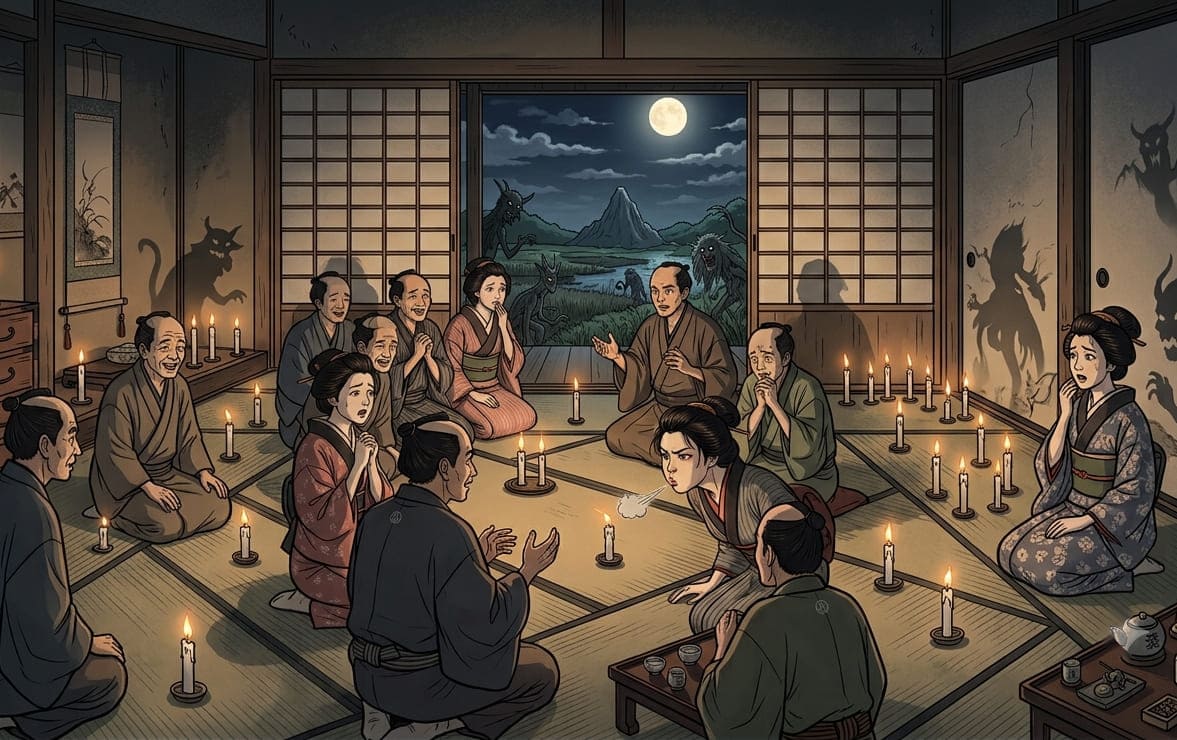
Imagine sitting in a dark room lit by nothing but candlelight.
A friend begins telling a ghost story. When the story ends, one candle is quietly extinguished.
Another story follows.
Another candle goes out.
As the room grows darker, the atmosphere changes. Every shadow seems to move, and every small sound makes your heart race.
Finally, only one candle remains.
What will happen when the last light disappears?
This is Hyakumonogatari (百物語), one of Japan’s most famous ghost story traditions.
For centuries, people gathered at night to share one hundred eerie tales, believing that something supernatural might appear after the final candle was extinguished.
Today, few people perform the ritual itself, but its mysterious atmosphere continues to inspire Japanese folklore, horror movies, anime, manga, and video games.
Whether you love ghost stories or simply want to explore Japanese culture, Hyakumonogatari offers a fascinating glimpse into Japan’s imagination, traditions, and love of the supernatural.

If you love ghost stories, you’re going to enjoy today’s topic!
- What Is Hyakumonogatari?
- How Does Hyakumonogatari Work?
- Why 100 Candles?
- What Happens After the Last Candle?
- Was Hyakumonogatari Really Dangerous?
- Why Do Japanese People Enjoy Ghost Stories in Summer?
- Hyakumonogatari in Modern Japan
- Hyakumonogatari in Games and Popular Culture
- Frequently Asked Questions
- Final Thoughts about Hyakumonogatari
What Is Hyakumonogatari?
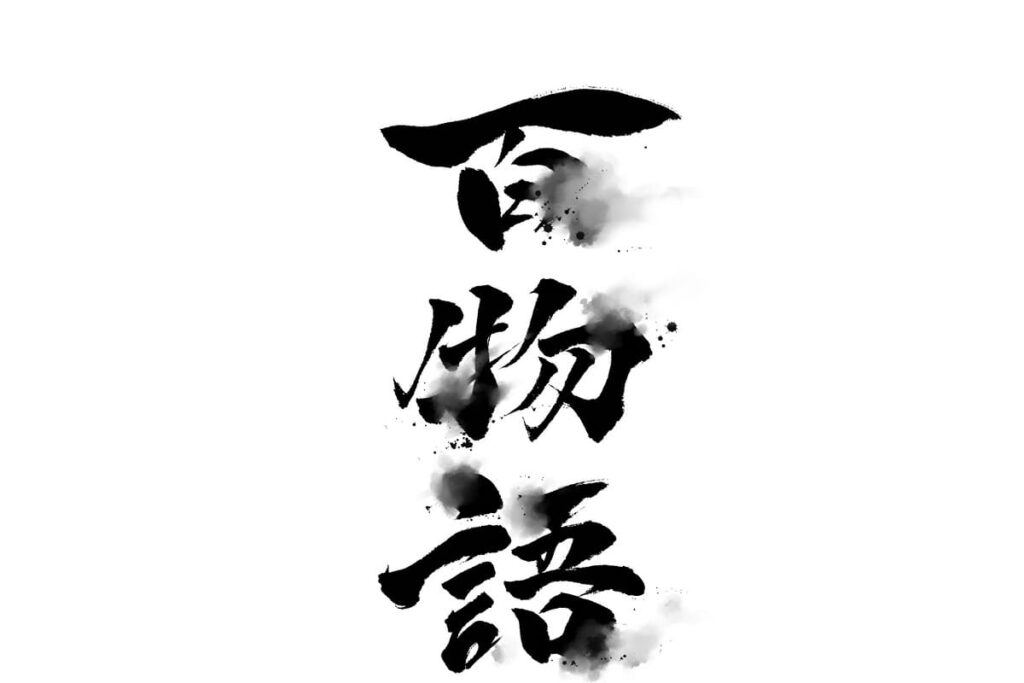
Hyakumonogatari (百物語), which literally means “One Hundred Stories,” is a traditional Japanese gathering where people take turns telling ghost stories in the dark.
The custom became especially popular during the Edo period (1603–1868), although its origins can be traced back to earlier centuries. It is believed to have first been enjoyed by samurai, who tested their courage by sharing eerie tales late at night. Over time, the tradition spread to ordinary people and became one of Japan’s best-known forms of supernatural entertainment.
Unlike modern horror movies, Hyakumonogatari was more than just a way to scare people. Many participants genuinely believed that telling one hundred ghost stories could invite spirits, ghosts, or mysterious beings into the room.
The ritual combined storytelling, imagination, and superstition, creating an unforgettable experience that blurred the line between entertainment and the supernatural.
Even today, the tradition continues to influence Japanese ghost stories and horror culture. Many classic ghost tales, urban legends, and even modern anime, manga, and video games borrow ideas and atmosphere from Hyakumonogatari.
In that sense, Hyakumonogatari is not just an old ghost game—it is one of the foundations of Japanese horror culture.
How Does Hyakumonogatari Work?
The rules of Hyakumonogatari were surprisingly simple—but that simplicity made the experience even more unsettling.
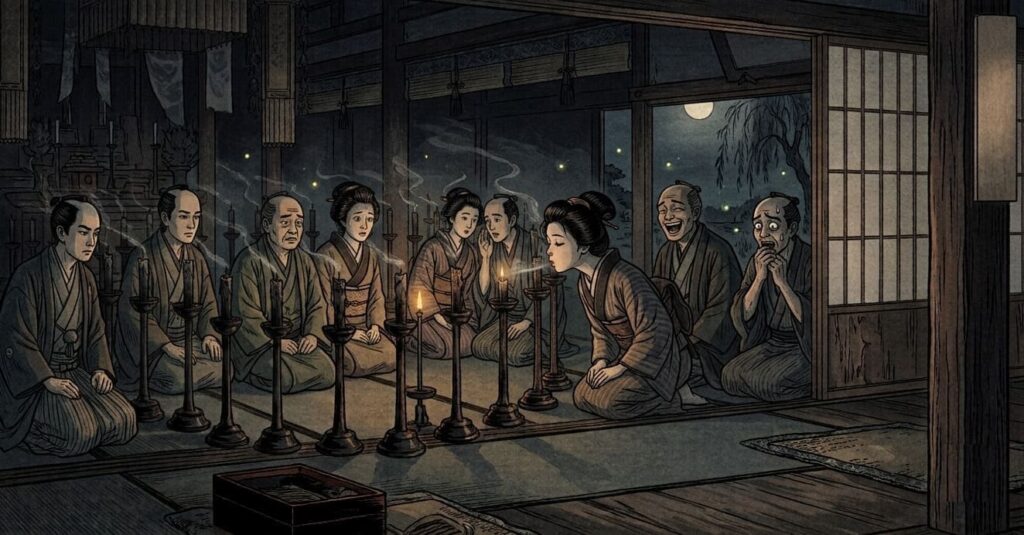
Participants gathered in a quiet room after dark, often with 100 candles or oil lamps arranged around the space. One by one, each person told a ghost story.
After every story, a single candle was extinguished.
The room became just a little darker.
Then another story was told.
Another candle disappeared.
The ritual continued until all one hundred stories had been shared.
As the number of flickering lights decreased, so did everyone’s sense of comfort. Ordinary sounds seemed louder. Shadows appeared to move. Even familiar faces became difficult to recognize in the dim light.

Blowing out a candle after every ghost story while the room grows darker and darker… I can only imagine how terrifying that must have been!
Nobody knew exactly what would happen when the final candle went out.
And that uncertainty was the most frightening part.
Some versions of the tradition even instructed participants to look into a mirror after extinguishing each candle, believing they might catch a glimpse of something that did not belong to the world of the living.
Whether or not anyone truly believed a ghost would appear, the ritual transformed a simple storytelling session into an unforgettable psychological experience.
Why 100 Candles?
Why one hundred stories?
Why not ten… or twenty?
No one knows for certain.
In Japanese culture, the number one hundred has long represented completeness or reaching a final stage. Finishing one hundred ghost stories symbolized crossing a boundary—moving beyond the ordinary world and into something unknown.
The candles themselves also played an important role.
With every flame that disappeared, the room became darker and quieter. Long before electricity existed, darkness carried a much stronger sense of mystery than it does today.
The flickering candlelight also affected the imagination. Shadows danced across the walls, familiar objects looked unfamiliar, and every sound seemed to echo through the room.
In other words, the candles were not just a source of light—they were part of the storytelling itself.
Each extinguished flame increased the tension, making every new ghost story feel just a little more believable than the last.
What Happens After the Last Candle?
This is the question that has fascinated people for centuries.
According to legend, when the final candle was extinguished, a ghost, spirit, or supernatural being would appear.
No one could say exactly what would happen.
Some believed they would encounter a yōkai.
Others feared they would see the ghost from one of the stories they had just told.
There were even tales of mysterious footsteps, strange voices, or an invisible presence filling the room after the last flame disappeared.
Whether these stories were true was never the point.
The anticipation itself created the fear.
As people listened to dozens of ghost stories in an increasingly dark room, their imaginations became more powerful than anything they could actually see.
Even the smallest creak of the floor or rustle of the wind suddenly felt supernatural.
Perhaps that is why Hyakumonogatari remained so popular for centuries.
It wasn’t simply about seeing a ghost.
It was about wondering whether the next moment might bring one.

Imagine reaching the ninety-ninth story.
Only one candle remains.
Would you have the courage to tell the final tale?
Was Hyakumonogatari Really Dangerous?
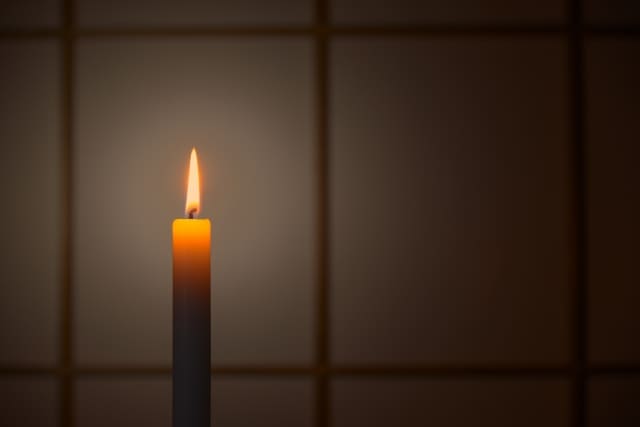
For people living centuries ago, the answer was often yes.
Many participants genuinely believed that completing all one hundred ghost stories could invite supernatural beings into the room. Ghosts, yōkai, or mysterious spirits were thought to be drawn to the darkness and the growing atmosphere of fear.
Because of this belief, some groups reportedly chose not to tell the final story.
Instead, they stopped after ninety-nine tales, leaving one candle still burning.
After all, why take the risk?
Whether these stories were true or simply part of the legend hardly mattered. The fear itself became part of the tradition.
Imagine spending hours listening to ghost stories in a room that grows darker with every passing tale.
By the time only one candle remains, your imagination has already begun filling the darkness with things that may not actually be there.
Even the sound of the wind outside or the creak of an old wooden floor could feel like proof that something unseen had arrived.
Perhaps the greatest fear of Hyakumonogatari was never the ghost itself.
It was the feeling that something might be waiting in the darkness.

Part of me would want to hear the hundredth story just to find out what happens next. But another part of me would probably stop at ninety-nine. I imagine it was a strange mix of curiosity, excitement, and fear.
Why Do Japanese People Enjoy Ghost Stories in Summer?
At first, it may seem strange.
Why would people choose the hottest season of the year to tell frightening stories?
The answer goes back hundreds of years.
During the Edo period (1603–1868), before air conditioners or electric fans existed, people looked for creative ways to escape the summer heat.
One popular idea was to experience a “cooling sensation” through fear.
A chilling ghost story could send shivers down your spine—even on a hot summer night.
Ghost stories also became popular in kabuki plays and public storytelling performances, making them an important part of Japan’s summer entertainment.
Even today, many Japanese television channels broadcast horror specials during the summer, and bookstores often feature collections of ghost stories around this time of year.
For many people in Japan, summer simply doesn’t feel complete without at least one good scary story.
In that sense, Hyakumonogatari is more than an old tradition.
It is part of a much larger culture that continues to shape how Japan enjoys the summer season.

In Japan, horror and summer go hand in hand. I still enjoy watching TV specials about ghost stories and paranormal experiences every summer—even as an adult!
Hyakumonogatari in Modern Japan
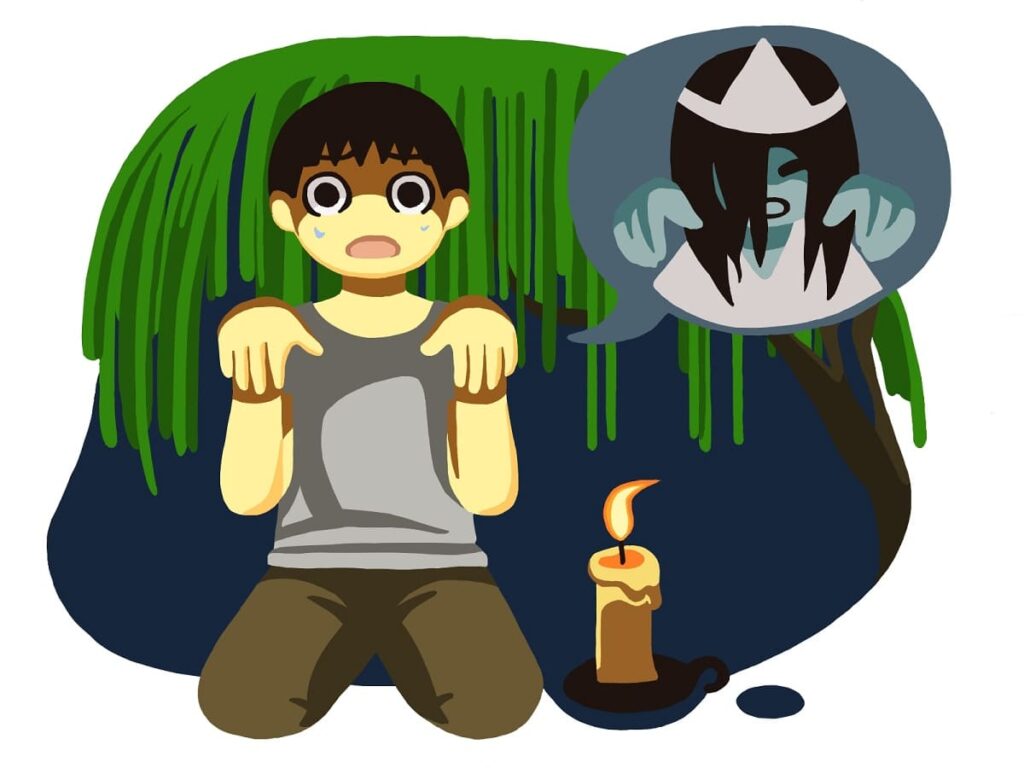
Although few people attempt the traditional one hundred-story ritual today, Hyakumonogatari has never truly disappeared.
Instead, it has found a new life through books, movies, anime, manga, and video games.
Many creators continue to draw inspiration from its mysterious atmosphere—the growing darkness, the suspense of each new story, and the unsettling question of what might appear after the final candle goes out.
In other words, Hyakumonogatari is no longer just a ritual.
It has become one of the foundations of Japanese horror storytelling.
For me, however, Hyakumonogatari also brings back childhood memories.
I never tried the full one hundred-story challenge, but during summer vacation, my friends and I often gathered in a dark room to tell scary stories.
School trips were especially memorable.
After the lights went out, we would whisper ghost stories under our blankets, hoping our teachers wouldn’t discover we were still awake.
Of course, the scarier the stories became, the louder our whispers grew.
Then someone would suddenly say,
“I think I saw someone outside the window…”
Instantly, everyone would scream, laugh, and huddle together.
Looking back, I sometimes wonder if people hundreds of years ago felt exactly the same way while playing Hyakumonogatari.
Not because they truly expected to see a ghost…
but because sharing fear with friends is strangely exciting.
Perhaps that feeling hasn’t changed at all.

Late-night ghost story sessions during school trips were always so much fun! Somehow, sharing scary stories made me feel much closer to classmates I hadn’t talked to very much before.

Come to think of it, we also told ghost stories late at night during a summer school camp. I still remember how eerie the sound of the waves felt because we were staying near the sea. Looking back, maybe that was our own Heisei-era version of Hyakumonogatari.

Hyakumonogatari in Games and Popular Culture
Although the traditional ritual is rarely performed today, Hyakumonogatari continues to influence Japanese popular culture.
Its mysterious atmosphere and suspense have inspired countless horror stories, novels, anime, manga, movies, and video games.
Rather than recreating the ritual exactly, many modern works borrow its central idea: the feeling that every new story brings you one step closer to the supernatural.
Fans of Japanese games may notice similar themes in titles such as Nioh, where mysterious yōkai and ghostly legends are deeply connected to traditional folklore. Even when Hyakumonogatari is not mentioned by name, its influence can often be felt in the eerie mood and storytelling.
This lasting influence shows that Hyakumonogatari is far more than an old custom.
It is a tradition that continues to shape how Japan tells scary stories today.
Frequently Asked Questions
- QIs Hyakumonogatari still practiced today?
- A
The complete one hundred-story ritual is quite rare today. However, people still enjoy ghost story gatherings, horror events, and seasonal traditions inspired by Hyakumonogatari, especially during the summer.
- QIs Hyakumonogatari based on a true story?
- A
No. Hyakumonogatari is a traditional storytelling ritual rather than a historical event. While many people in the past believed that supernatural beings might appear after the final candle was extinguished, there is no evidence that this actually happened.
- QWhy is Hyakumonogatari associated with summer?
- A
During the Edo period, ghost stories became a popular way to experience a refreshing chill during Japan’s hot and humid summers. That tradition continues today through horror movies, television specials, and seasonal ghost story events.
- QCan children play Hyakumonogatari?
- A
Many children in Japan enjoy telling scary stories with friends, especially during summer vacations or school trips. However, the original Hyakumonogatari ritual was traditionally considered a serious supernatural challenge, so modern versions are usually much more lighthearted.
Final Thoughts about Hyakumonogatari
Hyakumonogatari is more than a collection of one hundred ghost stories.
It is a tradition that brings together history, folklore, imagination, and the simple excitement of sharing mysterious tales with friends.
Whether people truly believed that spirits would appear after the final candle went out may never be known.
But perhaps that was never the most important part.
For centuries, people have gathered together, listened to frightening stories, laughed with friends, and wondered what might be hiding in the darkness.
The ghosts may have changed over time, but the excitement of a mysterious summer night has remained the same.
Perhaps that is why Hyakumonogatari still fascinates people today.
So the next time you hear a ghost story on a warm summer evening…
take a look into the darkness.
Who knows what might be waiting there?

Oh By the way! If you are interested in Yokai or in Japanese Culture and you are a gamer, you may love these games!
Let’s play!

Yes! I can’t wait to play these games!
Let’s Play!
Comments