






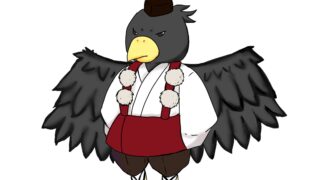




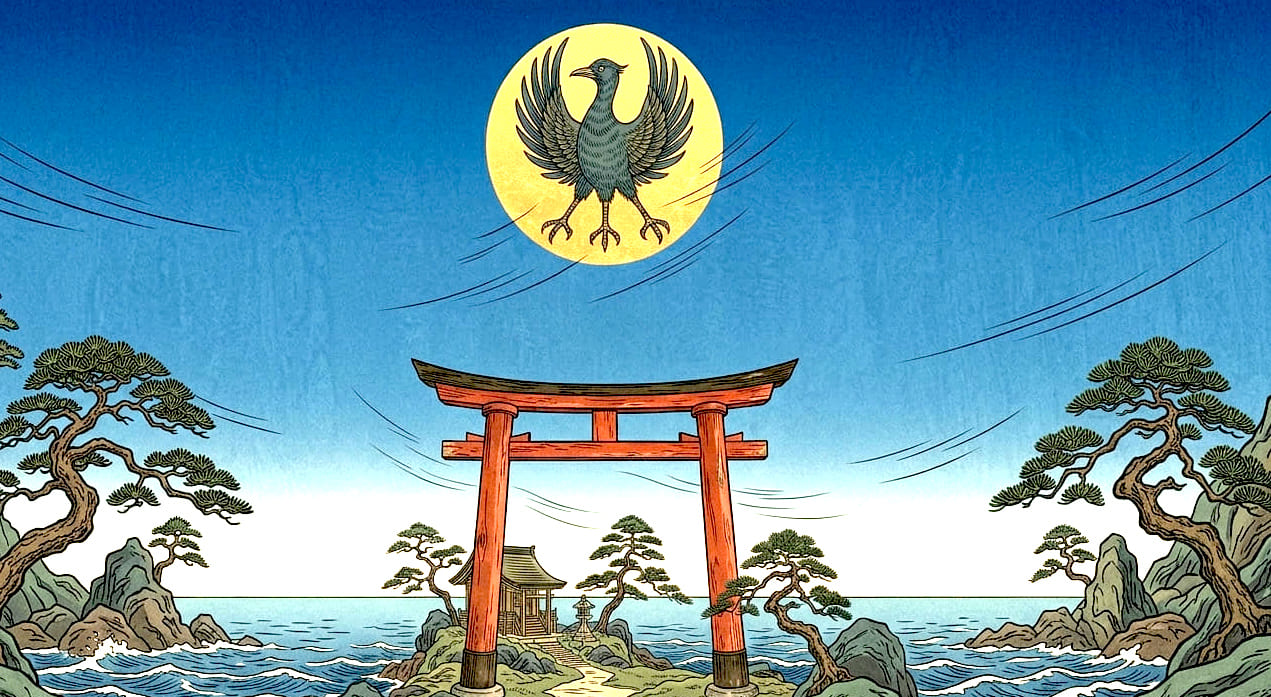
A giant crow with three legs. A divine guide. And a symbol you may have seen on the emblem of Japan’s national soccer teams.
This mysterious bird is known as Yatagarasu (八咫烏), one of the most fascinating figures in Japanese mythology.
According to ancient Japanese chronicles, Yatagarasu appeared during the legendary journey of Emperor Jimmu and guided him through the mountains of Kumano toward Yamato, in present-day Nara Prefecture.
But there is more to this famous crow than its three legs. The ancient chronicles do not actually describe Yatagarasu as having three legs. Its connection with the sun and the familiar image of the three-legged crow developed through later traditions.
So, what exactly is Yatagarasu? Why is it associated with Kumano? And why can you find this legendary crow on the emblem of Japan’s national soccer teams?
Let’s take a closer look at the story behind Yatagarasu—and discover how an ancient mythical bird continues to appear in Japan today.

Today’s topic is Yatagarasu. I don’t know much about it myself, so let’s learn about it together!
What Is Yatagarasu?

All right, let’s take a closer look at this mysterious crow!
Yatagarasu is a legendary crow associated with Japanese mythology, Kumano, and the idea of divine guidance.
The name is written 八咫烏 in Japanese. Yatagarasu is commonly translated as the “three-legged crow,” although the ancient Japanese chronicles do not actually mention that it had three legs.
In the Kojiki and Nihon shoki, Yatagarasu appears as a guide sent to the legendary Emperor Jimmu during his journey through Kumano. The crow helped lead him toward Yamato, where he eventually established his seat of government.
Because of this story, Yatagarasu has long been associated with guidance and finding the right path. At Kumano Nachi Taisha, for example, Yatagarasu is worshipped as a deity of guidance and safe travel.
Today, this legendary crow can be seen in places far beyond ancient mythology. It is closely associated with the Kumano region and is also featured on the emblem of Japan’s national soccer team.
Yatagarasu as a Divine Guide


Next, let’s look at a story that mythology fans might know.
One of Yatagarasu’s most famous appearances is in the story of Emperor Jimmu, the legendary first emperor of Japan.
During his eastern campaign, Jimmu and his followers faced difficulties as they traveled through the mountains of Kumano. According to the ancient chronicles, a great crow called Yatagarasu was sent to guide them toward Yamato, in present-day Nara Prefecture.
With Yatagarasu showing them the way, Jimmu and his followers were able to continue their journey. This story is one of the reasons Yatagarasu became associated with guidance and finding the right path.
In other words, Yatagarasu is not simply a mysterious crow in Japanese mythology. It is a creature that appears at a moment when people have lost their way—and helps them move forward.

Interested in other important figures from Japanese mythology? You can also learn about Ninigi-no-Mikoto, a central figure in the stories surrounding the imperial line.
Yatagarasu and the Kumano Region

Yatagarasu is also closely associated with the Kumano region, a sacred area in present-day Wakayama Prefecture.
The three grand shrines of Kumano—Kumano Hongu Taisha, Kumano Hayatama Taisha, and Kumano Nachi Taisha—have strong connections with the legendary crow. At these shrines, Yatagarasu is represented as a messenger and guide, and its image can be found on items such as talismans.
At Kumano Nachi Taisha, Yatagarasu is also worshipped at Miagatakihiko Shrine as a deity of guidance and safe travel.
The crow has therefore become one of the symbols associated with Kumano, connecting the ancient story of Emperor Jimmu with the spiritual traditions of the region today.

Kumano is a place I’d love to visit someday.
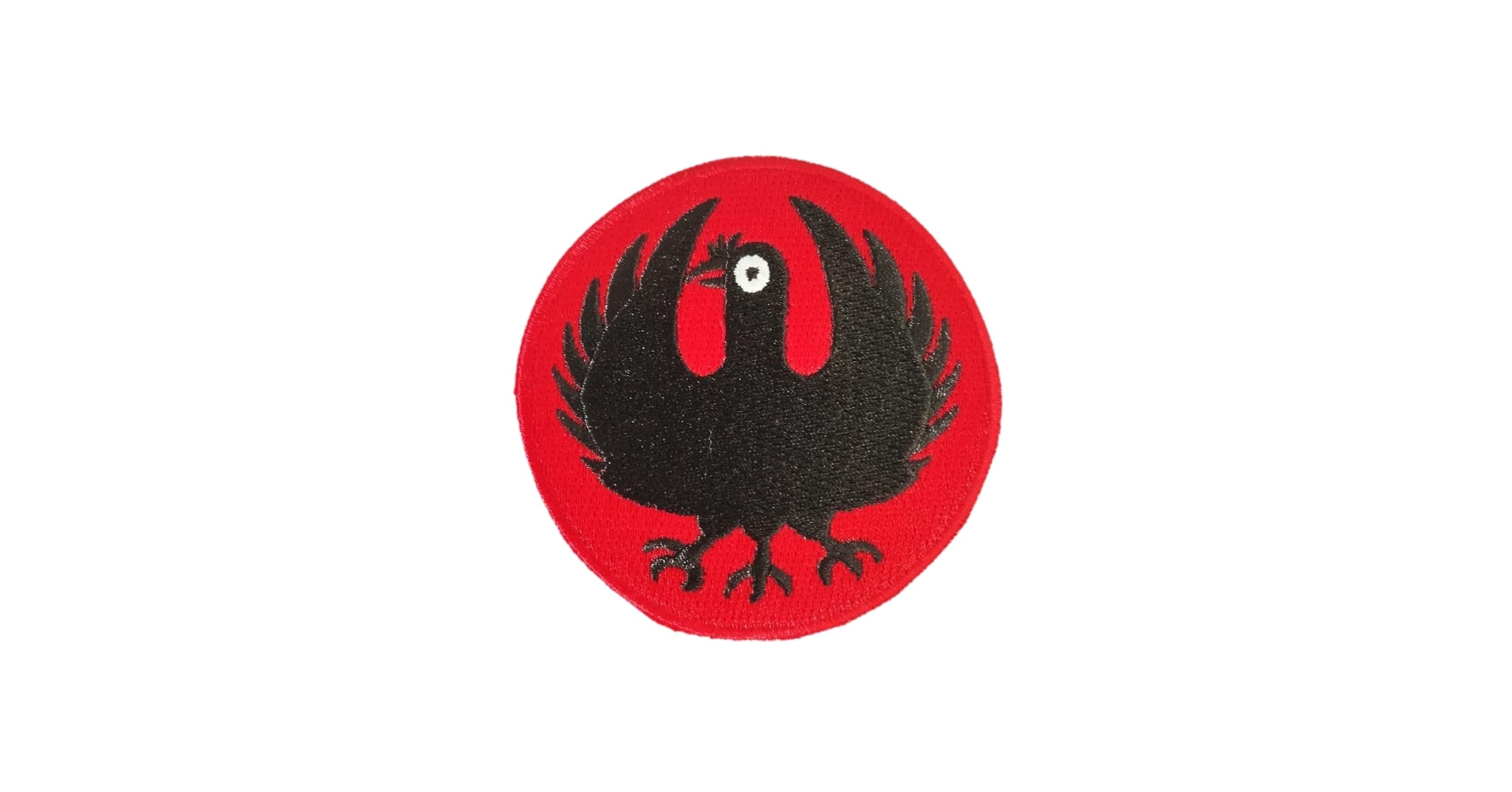

Was Yatagarasu Really a Three-Legged Crow?

If you have seen images of Yatagarasu, you have probably noticed its most unusual feature: three legs.
But here is something surprising: the ancient Japanese chronicles do not actually describe Yatagarasu as having three legs.
In the Kojiki and Nihon shoki, Yatagarasu is described as a great crow that guides Emperor Jimmu. The number of its legs is not mentioned. In other words, the familiar image of the three-legged Yatagarasu came later.
So where did the three legs come from?
The Three-Legged Crow and the Sun

One possible explanation lies in an older tradition from East Asia.
In Chinese mythology and folklore, a three-legged crow was believed to live in the sun. This bird became associated with the sun itself, and the image of a three-legged crow was later connected with Yatagarasu in Japan.
Because Yatagarasu was also understood as a divine messenger associated with the sun goddess Amaterasu, the image of a three-legged crow may have fit naturally with the Japanese tradition.
Want to learn more about Amaterasu, the sun goddess of Japanese mythology?
However, it is important to remember that this is an explanation of how the later image may have developed—not something stated in the Kojiki or Nihon shoki themselves.
What Does Yatagarasu Symbolize?
Because Yatagarasu appears at a crucial moment in Jimmu’s journey, when the way forward is unclear, the crow has come to symbolize guidance and finding the right path.
This symbolism continues in Kumano today, where Yatagarasu is associated with guidance and safe travel.
In this sense, Yatagarasu represents more than simply showing someone where to go. It can also symbolize the hope that, even when the way ahead is unclear, the right path can be found.
A Symbol of Good Fortune
Yatagarasu is also regarded as an auspicious symbol.
Although crows are often viewed as troublesome birds, Japanese traditions also include beliefs and rituals in which crows are associated with divination, good fortune, and a successful harvest. This gives the crow a very different image from the one many people might expect.
So Yatagarasu is not just a three-legged crow from an ancient myth. It has become a symbol of guidance, hope, and good fortune that still has a place in Japan today.
Yatagarasu in Modern Japan

Why Is Yatagarasu on Japan’s Football Emblem?

If you have watched the Japan national football team, you may have noticed a three-legged crow on the team emblem.
The crow is the symbol of the Japan Football Association (JFA), but its story is a little more complicated than simply saying, “It is Yatagarasu.”
The JFA explains that its symbol was designed by Jitsuzo Hinago in the early 1930s. The design was inspired by Yatagarasu from the story of Emperor Jimmu, but it also draws on the older East Asian tradition of the three-legged crow associated with the sun.
This is an important distinction. The three-legged bird we recognize today combines several layers of tradition rather than coming from a single ancient Japanese source.
The connection is also fitting because Yatagarasu has long been associated with guidance. Just as the mythical crow guides people along the right path, the bird on the football emblem has become a familiar symbol of Japanese football.
So when you see the three-legged crow on the Japan football emblem, you are looking at more than a simple sports logo. It reflects a fascinating mixture of Japanese mythology and older East Asian traditions.
![[商品価格に関しましては、リンクが作成された時点と現時点で情報が変更されている場合がございます。]](https://hbb.afl.rakuten.co.jp/hgb/573500a2.417a4bff.573500a3.355857e9/?me_id=1268779&item_id=10286473&pc=https%3A%2F%2Fthumbnail.image.rakuten.co.jp%2F%400_mall%2Fsports-lab%2Fcabinet%2Fadidas38%2Fdaz45-kd3345.jpg%3F_ex%3D240x240&s=240x240&t=picttext "[商品価格に関しましては、リンクが作成された時点と現時点で情報が変更されている場合がございます。]")



Yatagarasu in Nioh 2

I didn’t know much about Yatagarasu at first, but it became something I was curious about while playing Nioh.
Yatagarasu as a Guardian Spirit

In Nioh 2, Yatagarasu appears as a Guardian Spirit—a supernatural being that protects and supports the player in battle.
Rather than simply reproducing the mythical bird from ancient Japanese tradition, the game gives Yatagarasu a distinctive identity of its own. It has three legs and three eyes, and its abilities are closely associated with fire.
Yatagarasu is closely connected with Saika Magoichi, the famous gunslinger and leader of the Saika clan. After defeating Magoichi in the side mission The Third Word, players can obtain Yatagarasu as a Guardian Spirit.
Its abilities also fit well with Magoichi’s association with firearms and ranged combat. Yatagarasu provides bonuses related to ammunition and ranged attacks, while its fire-based abilities can help players deal with enemies affected by Scorched.
How Nioh 2 Reimagines Yatagarasu

Nioh 2 takes several familiar elements associated with Yatagarasu and gives them a darker, more fantastical interpretation.
The three-legged crow remains recognizable, but the game adds its own distinctive details, including three eyes and powerful fire-based abilities. In this version, Yatagarasu is not simply the divine guide of an ancient story. It becomes a powerful Guardian Spirit that fits naturally into the game’s world of warriors, firearms, and supernatural battles.

After learning about Yatagarasu’s long history as a mythical guide, it is fascinating to see how Nioh 2 transforms the legendary crow into a Guardian Spirit of its own.
Rather than simply copying the old legend, the game takes familiar elements of Yatagarasu and gives them new life through its dark fantasy setting.
Yatagarasu is just one of the many mythical beings that appear in Nioh. If you’re curious about other yokai and supernatural creatures in the game, check out my other Nioh guides.

Final Thoughts about Yatagarasu
Yatagarasu is much more than a three-legged crow from an ancient Japanese myth.
From the legendary journey of Emperor Jimmu to the sacred traditions of Kumano, Yatagarasu has long been associated with guidance and protection. Its image has even found a place in modern Japan as the symbol of the Japan Football Association.
In Nioh 2, this legendary crow takes on yet another form—as a powerful Guardian Spirit with three eyes, three legs, and fire-based abilities.
What makes Yatagarasu so fascinating is the way this ancient symbol continues to take on new meanings in different times and places. Whether you encounter it in Japanese mythology, at a shrine in Kumano, on a football emblem, or in a video game, there is always a little more to discover behind those three legs.
So the next time you see a three-legged crow, take a closer look. You might be looking at Yatagarasu.

Oh By the way! If you are interested in Yokai or in Japanese Culture and you are a gamer, you may love these games!
Let’s play!
Yes! I can’t wait to play these games!
Let’s Play!


Comments