










Imagine walking alone through a remote mountain path at dusk.
Suddenly, you hear the cry of a baby.
Concerned, you follow the sound and discover what appears to be an abandoned infant lying by the roadside.
You pick it up to help.
At first, it feels surprisingly light.
Then, within moments, the child becomes impossibly heavy.
Your legs buckle.
You collapse under the crushing weight.
According to Japanese folklore, you may have just encountered Konaki-jiji, one of Japan’s strangest and most unsettling yokai.
This mysterious creature combines the appearance of a crying baby with that of an old man and has frightened travelers for generations.
In this article, we’ll explore the legend of Konaki-jiji, its cultural meaning, and how this bizarre yokai continues to appear in modern games and anime.
- What Is Konaki-jiji?
- The Legend of Konaki-jiji
- Why Does Konaki-jiji Cry?
- What Happens If You Carry Konaki-jiji?
- Konaki-jiji and the Oppasho Stone
- Konaki-jiji in Modern Japanese Pop Culture
- What Does Konaki-jiji Symbolize?
- The Connection Between “Konaki-jiji” and “Konaki Junmai” Sake
- Frequently Asked Questions
- Final Thoughts about Konaki-jiji
What Is Konaki-jiji?
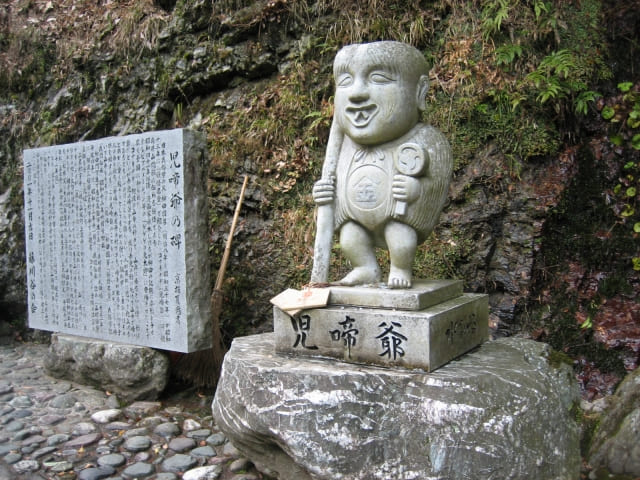
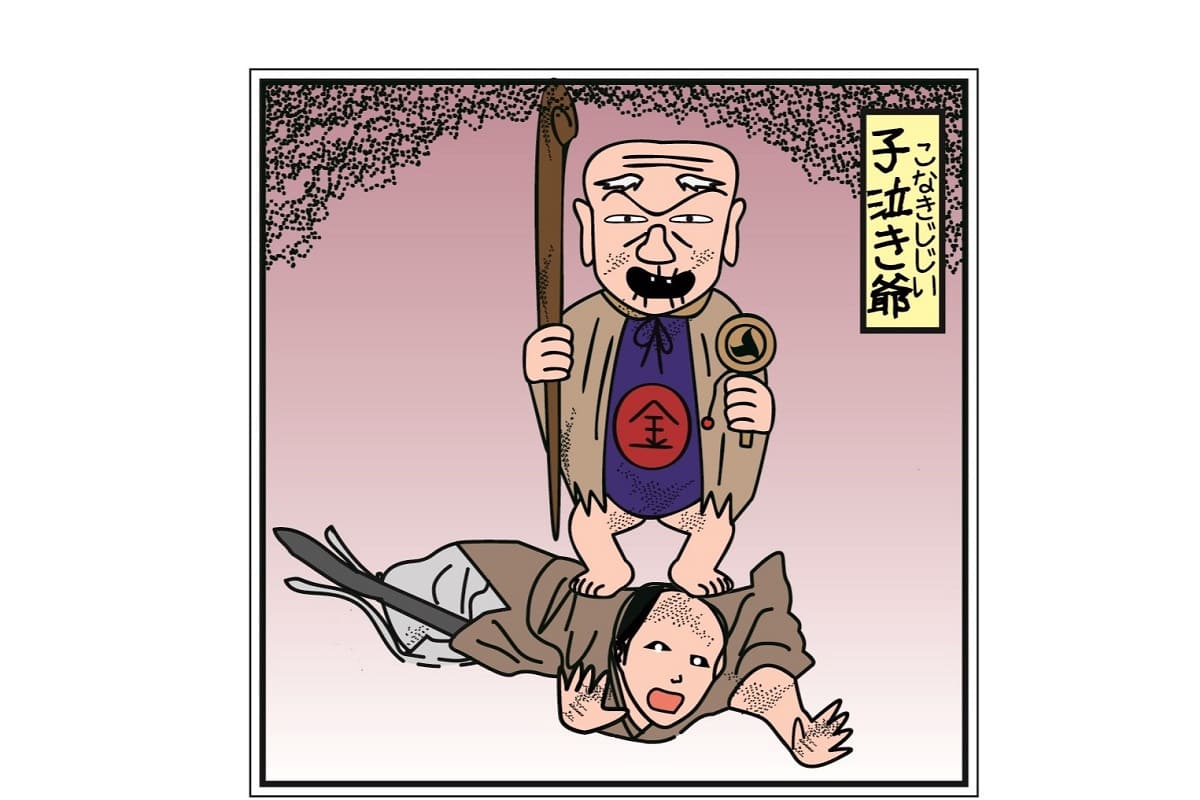
Konaki-jiji (子泣き爺) is a yokai from Japanese folklore best known for imitating the cry of an abandoned baby.
Its name can be translated as:
- Ko (子) = child
- Naki (泣き) = crying
- Jiji (爺) = old man
The result is a rather strange name:
“The Crying Child Old Man.”
Traditions vary by region, but Konaki-jiji is usually described as a supernatural being that appears in the mountains of Tokushima Prefecture on Shikoku Island.
Travelers who hear its cries often mistake it for a helpless infant and attempt to rescue it.
That decision rarely ends well.

It’s creepy that he’s an old man, yet he cries like a baby…
The Legend of Konaki-jiji
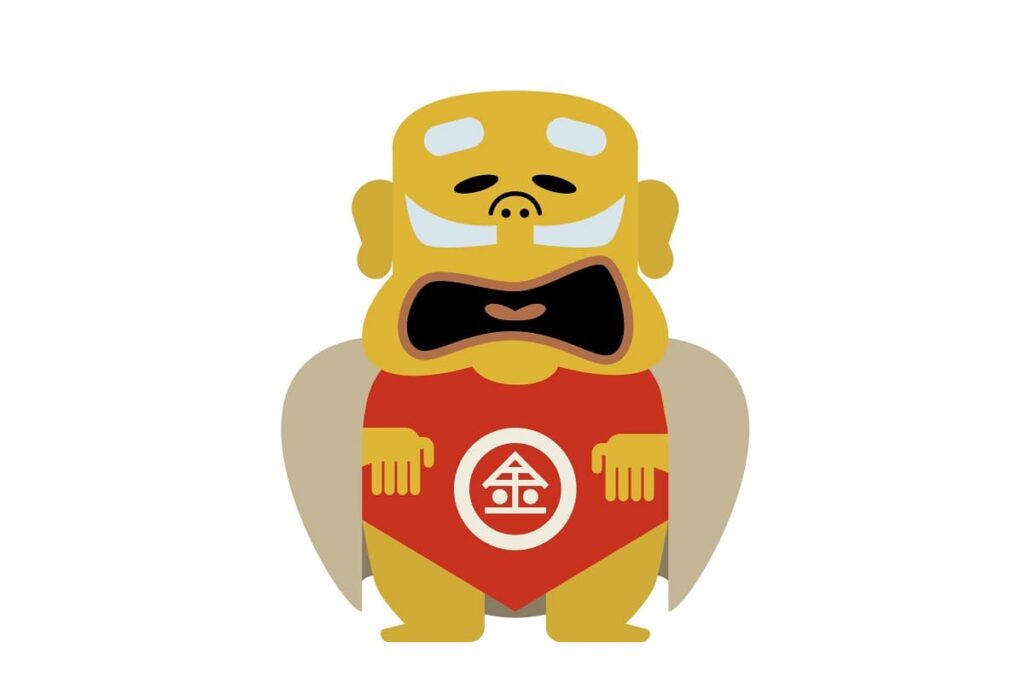
According to the most famous version of the legend, Konaki-jiji waits beside mountain paths and cries like a lost baby.
A kind-hearted traveler hears the sound and approaches.
Seeing what appears to be an abandoned child, the traveler picks it up.
Suddenly, the baby’s weight begins to increase.
Within moments, it becomes heavier and heavier until the victim can no longer stand.
Some stories say the traveler is crushed to death.
Others claim the yokai attacks after immobilizing its victim.
In certain regional versions, Konaki-jiji eventually transforms into the appearance of an old man, revealing its true nature.
The creature’s unsettling combination of infancy and old age is one reason it remains one of Japan’s most memorable yokai.

If I found a baby alone in the mountains, I’d probably pick it up without thinking. The fact that it gradually becomes as heavy as a stone is incredibly unsettling.
Why Does Konaki-jiji Cry?

The crying serves as a trap.
Like many yokai, Konaki-jiji exploits a basic human instinct: the desire to help someone in need.
A crying baby immediately triggers sympathy and concern.
The legend warns that appearances can be deceiving and that not every cry for help comes from a harmless source.
Some folklorists have suggested that stories like Konaki-jiji may also reflect fears associated with abandoned children, infant mortality, or the dangers of traveling through remote mountain regions.
In this interpretation, the yokai becomes more than a monster—it represents the anxieties and hardships of life in premodern Japan.
What Happens If You Carry Konaki-jiji?
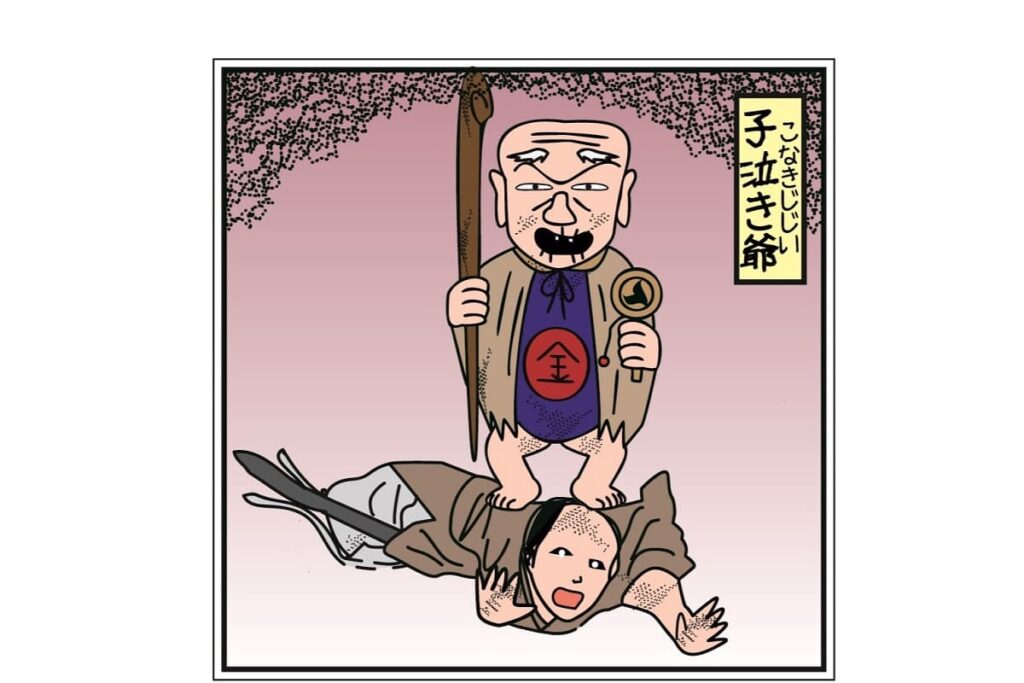
The encounter usually follows a predictable pattern:
1. You hear a baby crying
The sound comes from somewhere nearby, often in a mountain area.
2. You discover an abandoned infant
The baby appears helpless and vulnerable.
3. You pick it up
Believing you are helping, you lift the child into your arms or onto your back.
4. The weight begins to increase
The infant suddenly becomes impossibly heavy.
5. You are crushed
Unable to bear the weight, the victim collapses.
This simple sequence makes Konaki-jiji one of Japan’s most effective cautionary yokai.
The horror comes not from violence alone but from the victim’s own compassion being turned against them.

Come to think of it, Konaki-jiji has a pretty distinctive outfit. What exactly is he wearing?

He’s wearing a traditional haragake (a type of apron-like garment), and he’s often depicted carrying a straw raincoat called a mino on his back.

Konaki-jiji and the Oppasho Stone
An interesting aspect of Tokushima folklore is the similarity between Konaki-jiji and another local supernatural tale known as the Oppasho Stone.
Although they are generally treated as separate legends, both traditions originate from the mountainous region around present-day Miyoshi City in Tokushima Prefecture.
The two stories share several striking features:
- Travelers encounter a mysterious object or being
- The victim carries it on their back
- The burden becomes unnaturally heavy
- The experience leads to danger or misfortune
Because of these similarities, some researchers believe the stories may share a common folkloric origin.
Whether or not they are directly connected, both legends reflect the unique mountain folklore of Tokushima and the dangers once associated with remote travel.

Tokushima is home to some pretty creepy yokai, isn’t it?
Konaki-jiji in Modern Japanese Pop Culture
Despite being centuries old, Konaki-jiji remains surprisingly popular in modern Japan.
The yokai appears in manga, anime, video games, and other forms of entertainment, introducing new generations to this unusual legend.
Konaki-jiji in GeGeGe no Kitaro


One of the most famous versions of Konaki-jiji appears in GeGeGe no Kitaro.
In the series, he is portrayed as one of Kitaro’s allies rather than a terrifying monster.
However, he still retains his signature ability: increasing his weight to an extraordinary degree.
For many Japanese people, this version is their first introduction to the character.
Konaki-jiji in Nioh 2 and Nioh 3

Fans of action RPGs may recognize Konaki-jiji from the Nioh series.
In both games, the yokai appears as a troublesome enemy inspired by traditional folklore.
Just like the legendary creature, it can become incredibly heavy and difficult to deal with.
Many players consider Konaki-jiji one of the more irritating yokai encounters due to its defensive abilities and unpredictable attacks.
Its inclusion demonstrates how Japanese folklore continues to influence modern game design.

Konaki-jiji in Nioh is such a pain. That creepy scream is unsettling, and it just won’t stop attacking!
His attack always makes me cry

What Does Konaki-jiji Symbolize?
At first glance, Konaki-jiji may seem like nothing more than a strange monster story.
However, many yokai legends contain deeper cultural meanings.
Konaki-jiji can be interpreted as representing:
- The dangers of mountain travel
- Fear of the unknown
- The uncertainty of appearances
- Compassion exploited by deception
- Memories of hardship and child loss in rural communities
Like many traditional yokai, it functions both as entertainment and as a cautionary tale.
The Connection Between “Konaki-jiji” and “Konaki Junmai” Sake

Interestingly, the legend of Konaki-jiji has even influenced the world of sake, with a local sake named “Konaki Junmai” drawing inspiration from this yokai. Produced in Tottori prefecture, Konaki Junmai is a traditional junmai sake, known for its rich, deep flavors.

Tottori is known as hometown of Mizuki Shigeru (“Gegege no Kitaro” author ).
The sake is said to carry the spirit of the Konaki-jiji legend—offering a full-bodied taste that surprises drinkers with its weight and complexity, much like how the yokai surprises those who encounter him. It’s a must-try for anyone visiting the area or interested in exploring Japan’s unique folklore through food and drink.
![[商品価格に関しましては、リンクが作成された時点と現時点で情報が変更されている場合がございます。]](https://hbb.afl.rakuten.co.jp/hgb/40fd82df.0dcb4ac2.40fd82e0.50375ccd/?me_id=1233854&item_id=10006115&pc=https%3A%2F%2Fthumbnail.image.rakuten.co.jp%2F%400_mall%2Fm-sakaya%2Fcabinet%2Fshohin02%2Fimgrc0094892731.jpg%3F_ex%3D240x240&s=240x240&t=picttext "[商品価格に関しましては、リンクが作成された時点と現時点で情報が変更されている場合がございます。]")

Frequently Asked Questions
- QIs Konaki-jiji evil?
- A
Not necessarily.
In folklore, Konaki-jiji acts as a dangerous supernatural being, but some modern portrayals depict it as friendly or even comedic.
- QIs Konaki-jiji a baby or an old man?
- A
Interestingly, it is often described as both.
Many legends begin with the appearance of a crying baby, while others reveal the creature’s true form as an old man.
- QWhere does the legend come from?
- A
The most famous stories originate from Tokushima Prefecture on Shikoku Island, particularly the mountainous areas around modern-day Miyoshi.
- QIs Konaki-jiji based on a real story?
- A
There is no evidence that Konaki-jiji is based on an actual historical event.
Like many yokai, it likely developed from local folklore and oral traditions.
- QDoes Konaki-jiji appear in video games?
- A
Yes.
The yokai appears in the Nioh series and has inspired numerous depictions in Japanese popular culture.
- QWhere is the legend of Konaki-jiji most famous?
- A
While Konaki-jiji is known throughout Japan, the legend is most famous in Yamashiro Town, Miyoshi City, Tokushima Prefecture.
- QWhat does Konaki-jiji do to trick people?
- A
Konaki-jiji mimics the sound of a crying baby to lure people into picking him up. Once lifted, he becomes extremely heavy, often making it impossible for the person to move.
- QHow is Konaki-jiji portrayed in GeGeGe no Kitaro?
- A
In GeGeGe no Kitaro, Konaki-jiji is portrayed as a gentle, elderly yokai who helps the protagonist Kitaro. However, he retains his folkloric ability to become incredibly heavy and defeat enemies with his strength.
 Otsuki
If you are interested in famous Yokai in Japan,
check the article below! 12 Famous Yokai in Japanese Folklore (Explained)Japan is home to many mysterious supernatural creatures known as yokai. Discover 12 famous yokai from Japanese folklore, their stories, and what they represent in traditional culture.manekinekogames.vidaennippon.com
Final Thoughts about Konaki-jiji
Konaki-jiji is one of Japan’s most unusual yokai—a creature that combines the innocence of a crying child with the menace of a supernatural trickster.
For centuries, its eerie cries have echoed through Japanese folklore, warning travelers that appearances can be deceiving.
Whether encountered in an old mountain legend, an anime series, or a modern video game, Konaki-jiji remains a fascinating example of how traditional Japanese folklore continues to survive in the modern world.

Oh By the way! If you are interested in Yokai or in Japanese Culture and you are a gamer, you may love these games!
Let’s play!

Yes! I can’t wait to play these games!
Let’s Play!
Comments